


This week the government announced that it would cut up to nine thousand public service jobs, looking to make savings by merging government departments with similar back office functions, as well as leveraging productivity improvements due to AI.1
While I do believe that at some point the transformation of public services due to AI will be both desirable and necessary, just telling public servants to “use AI” will deliver marginal gains at best, aside from in specific use cases like coding agents for cybersecurity and IT where they are doubtless already utilized. I believe this announcement is instead a combination of negative patronage politics due to most public servants being left voting Wellingtonians, a way to save some money before this year’s likely tight budget, and LinkedIn AI psychosis.
People Aren’t The Cause of Government Inefficiency
The biggest problem with this decision is that it incorrectly lays the blame of government ineffectiveness at the foot of public servants, the vast majority of whom I believe are competent and civic minded. The problem is instead the system that they operate in, and its incentives.
In New Zealand, we have a relatively larger state than some other places. Bigger than Australia and the US in terms of spending as a share of GDP, but smaller than Sweden, Finland, or the UK.2 In absolute terms, our government spending per capita is low for the OECD, mostly because we are poorer than other places. For example, the US spends less on the government as a % of GDP, but gets more out of it because their GDP per capita is much higher.3
It is true that New Zealand’s wages of public sector employees as a percentage of government spending is well above average for a high income country in the OECD4. This depressingly coincides with a lack of state capacity to deliver basic services such as healthcare and infrastructure. However, blaming public servants for a lack of delivery would be a mistake.
To really understand where the ineffectiveness of the state comes from we need to zoom out. When your proverbial Auckland swing voter thinks about government ineffectiveness in New Zealand, they mostly think about tangible things around them that aren’t working, such as public disorder in the CBD, scarce housing, poor healthcare, and a widening infrastructure deficit.
The causes of these failures are complex and interconnected, but a lot of them are on display if we look at The City Rail Link, Auckland’s upcoming commuter rail project. The CRL is a perfect example of a big project that blows out its budget and gets delivered late, a common failure mode for New Zealand government. It was literally used in a presentation by a Chinese contractor as an example of expensive and slow rail construction. (We’re the “before” photo!).5
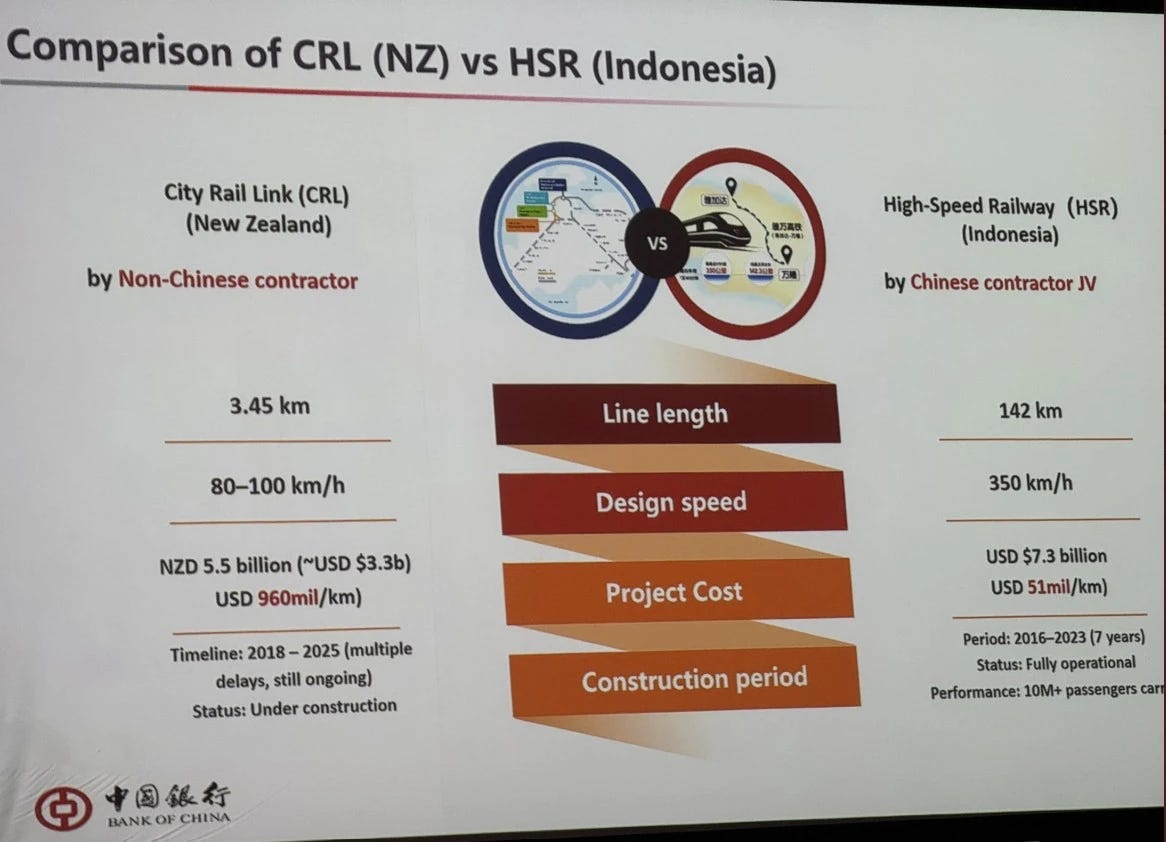
To understand why the CRL is late and expensive, we need some intellectual background. Scholars have long surmised that countries in the Anglosphere suffer from a “vetocracy” in which it is too difficult to get basic things done due to a excessive number of legal veto points, which is possibly a result of the English common law tradition we share, which allows for a extensive scrutiny of government action. Ironically, in the US at least, this vetocracy has resulted in a dangerous concentration of power in the executive due to the need to get things done regardless of Congressional gridlock. 6
However, it took the recent centre left “Abundance” movement7 to mainstream these concerns about government efficacy. Although incomplete as a causal model for what ails us, it basically hits the nail on the head as to why we struggle to deliver housing, infrastructure, and services. At the core of Abundance is the idea that government fails to deliver because of both excessive legal proceduralism and a lack of state capacity.
Excessive legal proceduralism comes from a multitude of “veto points” that stop things from getting done, i.e endless public and environmental reviews, and in the US specifically, a culture of suing to block development. For example, a recent renewable energy development which would have been NZ’s biggest wind farm was initially blocked by an environmental review because of its effect on lizards and bats, before being approved by fast track. There are real tradeoffs to every project, but we can’t just say no to everything.8
As for state capacity, Neoliberal privatization has eroded the government’s core function such that the delivery of core services are now outsourced to grifting nonprofits and contractors who have the incentive to delay and run up the bill.9
If we examine those Auckland swing voter concerns through this abundance lens, their causes start to make sense. Housing is scarce because of zoning and heritage laws and a review process that make it functionally illegal to build denser housing. Homelessness is caused by a lack of housing supply, which bleeds into public disorder. When citizens are disturbed by public disorder, there is no recourse because the state doesn’t have the capacity or the legal ability to institutionalize those who can’t safely be in public. Hospital waiting times reflect restrictions on doctors qualified overseas, and an inability to build public infrastructure such as hospitals. None of these things are caused by public servants being bad at their job, they are caused by artificial scarcity and a lack of state capacity - weak and overly constrained government.
Government has failed to deliver even when staffing levels were relatively high - think back to the infamous Kiwibuild debacle of 2017, where an army of civil servants experimentally verified the theoretical upper bound on how many Wellington staffers they could use to build a single house.
The key is having “state capacity” - i.e the right sort of people, which for Kiwibuild would mean bringing back a Ministry of Works, staffing it with state employed engineers, and legally empowering them to deliver things through mechanisms like fast track that bypass excessive proceduralism in the name of public good, not corrupt pet projects.
This framing also negates the idea of AI based productivity boosts being a panacea for delivering better public services, because the productivity of individual civil servants isn’t the bottleneck on government being able to deliver - it’s the system and it’s incentive structures!
How Should We Really Approach AI and the Public Sector
If we want to use AI in a way that really improves the delivery of public services, we must do three things - secure access to the best AI models and infrastructure, build state capacity in AI, and judiciously apply AI to eliminate bottlenecks to delivery of services.
Build State Capacity in AI and Apply it to Eliminate Bottlenecks
Firstly, we must build serious state capacity in AI, including monitoring so that ministries have up to date advice about what AI can do, and how it is impacting New Zealanders overall. This must be in house, not outsourced to contractors or non profits. I have made the case for an AI safety institute previously, although now I prefer the term AI monitoring institute as it reflects the more broad mission of “having the government understand AI”. It’s not enough to just measure the properties of AI through benchmarks or alignment tests, to ensure systemic safety we must also hire economists and psychologists to measure the impact on our society.

It’s early days on the state capacity front, but we’re not starting from scratch - the government has done some advisory work on how AI can be applied already - last year we came out with a list of guidelines on AI use to the public sector - the Public Service AI Framework.10 We have also launched an anemic initiative called the Public Service AI Work Program, which aims to create shared templates for government usage of AI.11 This is good and necessary, however, it is not enough of an investment - we cannot prepare for a technology as transformative as AI with 3.5 FTE staff at MBIE making slide decks about how to use copilot to generate excel formulas.
The second part of this process of building state capacity is embedding AI into the government at a fundamental level, which would best be done by integrating forward deployed AI engineers into existing teams, and helping them apply AI in ways that respect the expertise of existing civil servants. This would mean focusing on automating bottlenecks to delivery, not human judgement or workers. For example; Ministry for the Environment staffers could collaborate with computer vision specialists to classify land use from remote sensing data12 and identify areas open for development to avoid environmental review delay. The IRD could use AI to better process documents during audits, allowing for the easier detection of fraud or waste in government. Local council could use AI to quickly summarize large amounts of public feedback to better enable direct democracy. The bottom line is using AI to unblock the system and improve its incentives, however, we can only do this if we have access to AI.
Securing New Zealand’s Access to AI
As a developed, liberal democratic middle power, New Zealand is strong when it comes to adopting AI, and we have the institutional capacity and flexibility to build a good governance system. Assuming we have access to AI, we will apply it well.
However, the brute fact is that the best models in the world are made primarily in the US, and secondarily in China. The US makes closed source cutting edge frontier models, and China makes competitive open source models, which are often more efficient due to US export controls on chips to China. The US controls 75% of frontier compute, and China controls 15% and growing, with domestic efforts underway to build chip manufacturing capacity.
According to a recent Chatham House research paper on middle power AI strategy13 the optimal strategy for middle powers therefore doesn’t involve building our own AI, but rather having the ability to influence the development of AI, and deploy it domestically in line with our national interests.
Let’s assume the scenario where there is no AI bubble or AI winter (I’m unsure about this for the record). If AI progress continues, I believe there will be a shortage of access to top quality models. The best models are becoming more compute intensive over time, not less, absorbing efficiency improvements into further scaling to eke out marginal intelligence gains.14
We are already seeing a rolling release of the most powerful models. For example, in the case of Anthropic’s latest model Mythos, which is excellent at finding and exploiting code vulnerabilities, there has only been a limited rollout to select American tech companies, banks, and intelligence agencies. We are already seeing EU officials recommend that they request access to Mythos from the US to secure their own systems.15
As models get better, they represent more of a strategic asset, and will be controlled as such by governments. We are seeing this now with cyber, but it will soon spread to other domains with misuse risk, like biology. Thus the need for New Zealand to secure access is critical to any plans we will have to transform our public sector. Having continued access to the best models will also be vital for our economic competitiveness and national security.
Let Them Build
The way that I propose to secure this access is through foreign direct investment of datacenter construction on the condition that NZ will have access to models or chips hosted in these datacenters.
I know, I know, everybody hates datacenters. When it comes to 2026 unpopularity power rankings, they’re sitting in the same tier as the Iran War, Epstein, and paid streaming services with ads. Despite concerns about things like water usage being mostly online misinformation, I do understand the reality that every datacentre built is one step closer to advanced AI, which people rightfully feel nervous about. However, those datacenters are getting built one way or another, and I’d rather have them in New Zealand, where we extract concessions in exchange for their construction.
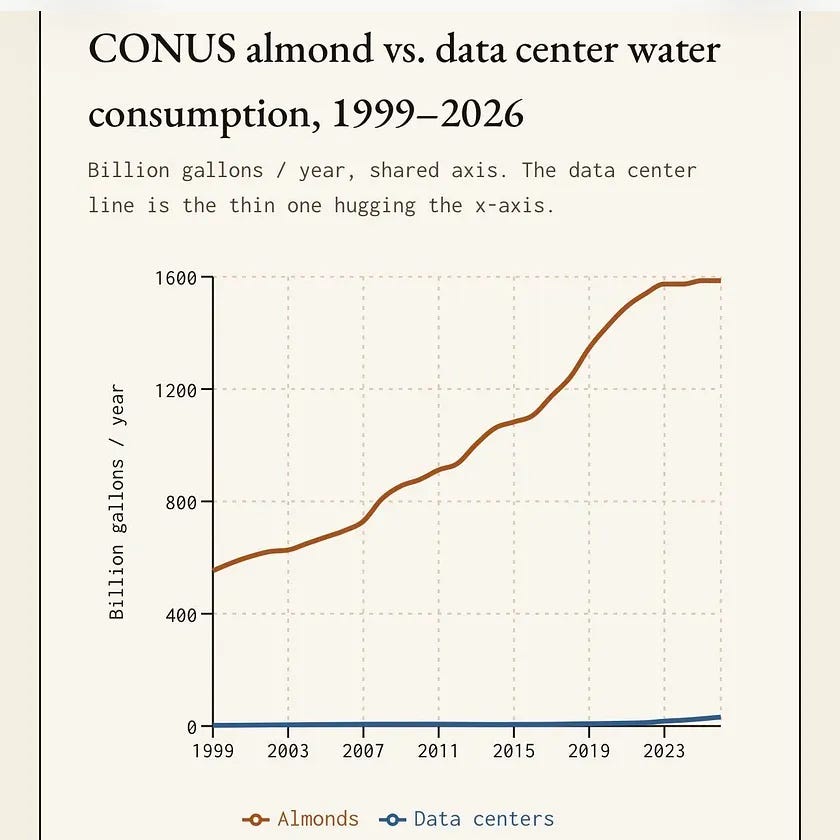
This is why I’m only pro datacenter construction where there is upside for New Zealanders - we should insist on getting renewable energy buildouts, grid upgrades, and access rights to the best models and chips every time we let someone build a datacenter here.
There is already a datacenter buildout underway in New Zealand, and it’s not hard to understand why - we are a country with good environmental conditions for datacenters, a strong renewable energy buildout, reforms that should allow for reasonable permitting and review times, and New Zealand is exceedingly safe and peaceful by international standards.
To give a concrete example; near my birthplace of Dunedin is Southland, a region with a cold, rainy climate and lots of hydroelectric power. Southland is mostly rural farmland, sparsely populated, and open to economic development. Because of these qualities, Southland has been seen as optimal for datacenter construction. In fact, the first hyperscalar compatible data centre in NZ will soon be constructed just outside of Invercargill. It will be partially powered by the fast tracked Slopedown wind farm, a nearby development that when constructed will be New Zealand’s largest.
A good objective here would be to pursue a more NZ friendly, scaled down version of the Stargate project OpenAI brokered with the United Arab Emirates.16 In this deal, the UAE agreed to allow OpenAI (in partnership with NVIDIA, Oracle, and Softbank) to build out a large compute cluster in exchange for the deep integration of OpenAI models throughout their public service. Hosting the chips themselves gives them the ability to do local inference on sensitive information, which is a major concern when using AI for government operations.
To land a deal like this wouldn’t require a huge change in how we are approaching the construction of datacenters or renewable energy, but a pragmatic stance and buy in from the public. When it comes to the AI transition, optionality is good, and we have to make unpleasant tradeoffs to stay competitive as a country. Letting others build out compute infrastructure here on their own dime in exchange for access is a low downside, high upside play for New Zealand.
In summary, I welcome the government’s engagement with AI. However, its current messaging around job cuts and AI replacement misunderstand both what actually causes government inefficiencies, as well as how AI can actually be used to help government workers deliver better public services. A stronger AI strategy would include a dedicated AI monitoring institute, bottom up AI integration, and a globally minded AI procurement process that secures access to cutting edge models through hyperscalar investment in datacenter construction. All in all, getting AI to work in government requires a bit more investment than booting thousands of young kiwis to Melbourne and getting everyone left in Welly onto copilot. For heavens sake, at least get some Claude subscriptions so that NZ policy isn’t being written with gpt4o-mini.
https://www.beehive.govt.nz/speech/pre-budget-speech-business-north-harbour
https://ourworldindata.org/grapher/historical-gov-spending-gdp
https://ourworldindata.org/grapher/total-gov-expenditure-percapita-oecd
https://ourworldindata.org/grapher/share-of-employee-compensation-in-public-spending
https://thespinoff.co.nz/society/20-10-2025/please-god-when-is-the-crl-going-to-open
Fukuyama, F (2014) Political Order and Political Decay
Ezra Klein and Derek Thompson, Abundance (New York: Avid Reader Press / Simon & Schuster, 2025)
https://thespinoff.co.nz/society/14-05-2026/its-time-to-call-a-moratorium-on-giving-businessmen-honours
https://www.odt.co.nz/news/dunedin/new-fears-cost-blowouts
https://www.digital.govt.nz/standards-and-guidance/technology-and-architecture/artificial-intelligence/public-service-artificial-intelligence-framework
https://dns.govt.nz/standards-and-guidance/technology-and-architecture/artificial-intelligence/public-service-ai-work-programme
https://github.com/allenai/olmoearth_pretrain
How middle powers can weather US and Chinese AI dominance, Chatham House, 2025
https://www.aisi.gov.uk/blog/how-do-frontier-ai-agents-perform-in-multi-step-cyber-attack-scenarios - model performance scaled log-linearly at cyber attacks with inference-time compute
https://www.reuters.com/legal/litigation/eu-should-seek-access-anthropics-mythos-bundesbank-says-2026-04-29/
https://openai.com/index/introducing-stargate-uae/